


An important geological formation
From an altitude of 1200 meters, on the White Mountain highlands, 43 kilometres South - west of Canea, the Agia Eirini gorge plunges southward into the blue waters of the Libyan Sea. The stream that has been eroding the calcareous and phyllitic mountain rock for many million years, is still following its course at the bottom of the gorge. South-western Crete enjoys temperate weather, with α long dry and hot season and sud-den rainstorms in the fall and spring.
Flora
The gorge's varied vegetation is typical of the East-ern Mediterranean flora, dominated by Calabrian pine (Pivus brutia), Cypress (Cypreseus sempervirens var. horizontalis) and Oriental plane (Platanus orientalis), found mostly in close proximity to the stream bed, and Cretan maple (Acer creticum), common in the eastern parts of the gorge. Α great and colorful variety of shrubs and smaller plants adorns the gorge. The slopes are covered with Cretan dittany (Orisanum dictamnus), renowned as an excellent herbal remedy.
Fauna
Many animal species find refuge in the wild and inaccessible environmnent of the gorge. Rare and en-dangered birds such as Lammergeier (Gypaetus barbatus) and Golden eagle (Aquila chrysaetos) hover overhead, and the maquis is teeming with other less rare species. Mammals include the unique wild goat subspecies (Capra aegagrus cretica). Many other animal and plant species are endemic to the island.
Historical information
The Agia Eirini area, inhabited by man since remote antiquity, also includes several cultural treasures: Ancient cities such as Elyros, Suia, Lissos, Poikilassos and Hyrtakina, temples of Aesculapius, funeral sites, cyclopean walls, churches, and also the signs of many fights for national freedom and the everyday struggle for a better life. Agia Eirini holds historical testimony to the prehistoric period, classical Greece, the roman and byzantine periods, liberation and the struggles of world war two. The Agia Eirini gorge is a breathtaking sanctuary for all that life past and present, geological formations, plants, animals and memories of man's momentous pas-sage for many millenia.
From informatory leaflets of the Forest Department of Chania Prefecture
Photos
-


Map
-
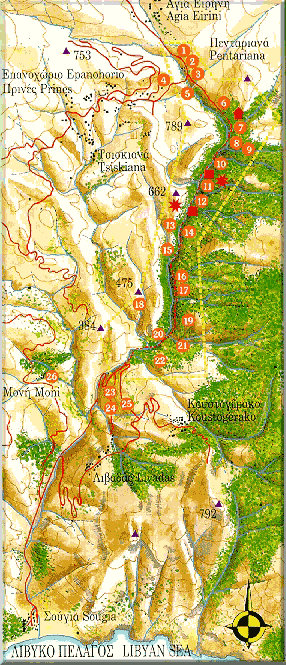
- Yellow line - Boundaries of protected area
- Red line - Trail (7 km)
- Red arc upwards - Ranger station
- Red rectangle - Rest area
- Red star - Scenic view
1. Bridge to Omalos plateau
2. Christos
3. Agios Georgios
4. Parking area
5. Porofarago
6. Το Fygous gorge & Hionotrypa
7. Ai-Giannis rock shrine
8. Ροlla Spitakia
9. Kargadoros
10. Mesa Kampia
11. Kato Kampia
12. Petrodiofyro
13. Vigla
14. Maragon Kampia
15. Gaiduroporos
16. Trail to Madara-Faragoulia
17. Fabrika
18. Mouroi
19. Lekka Honos (Cave)
20. Το Aspalathropezoula
21. Spiliara
22. (Spring) (Quelle) Zourida
23. Ai-Dimitris
24. Trail to Livada
25. Trail to Κoustogeraco
26. Panagia i Kera