

Pobeda (7.439 m) is the highest mountain of the area Tian Shan, which is located on the borders connecting Kyrgyztan and Kazakstan with China. Pobeda (7.439 m) is the highest mountain of the area Tian Shan, which is located on the borders connecting Kyrgyztan and Kazakstan with China.
It is a massif vault, covered with snow and ice, located only 10 miles south of the second highest peak of the area, the Khan Tengri (7.010 m).
Up until the 1930's the Khan Tengri was considered to be the highest peak in Tian Shan. The icy mass covering Pobeda, which is almost always hidden behind thick clouds, had slipped the attention of the mountaineers - explorers of the time. The geographical discovery of the peak Pobeda was achieved in 1943 and the first successful ascension (climbing) in 1956 during an expedition under the leadership of V. Abalakov, after having struggled for 30 days.
Many climbers had attempted to reach the "forbidden peak" - the result being more often than not tragic - like in the case of 1955, when 11 out of 12 members of the expedition from Kazakh, died in their tents at the 6.900 m, during a terrible snowstorm.
Pobeda is the northest peak over 7.000 m around the world. The weather conditions during the ascension are particularly cruel. The rare sunny days are interrupted by large periods of bad weather, during which the icy wind is reaching high velocity levels, which hinder the ascension tremendously. Its main difficulty is the frequent avalanches along with the long-hour course in an altitude of 7.000 m. It demands technical skills, excellent physical condition, not to mention good psychology. All that constitutes a great challenge for today's mountaineers - ascenders. This is the reason why the conquest of this particular peak will be marked as a milestone success of the Greek Mountain Climbing Community.
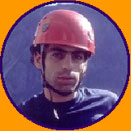 Nikos Hadjis
1973 Athens, Student of Silviculture
Mountain Climbing Instructor of the Greek Alpine Club Mountain Guide
member of the Mountain Guides Association.
He is systematically involved in the sport since 1989.
Many climbs in the French, Swiss, Italian Alps, Ben Nevis - Scotland, Nissebal - Norway
Expeditions:
1996 Mustag Ata 7.546 m
China 1998 Kusum Kanguru 6.393 m
Nepal 1998 Kwangre Ri 6.182 m
Nepal 1998 Dhaulagiri 8.167 m - Nepal
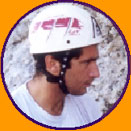 George Ganglbauer
1970 Austria, employed in the private sector
Mountain Climbing Trainer Nominee of the Greek Alpine Club.
He is systematically involved in the sport since 1993.
Many climbs in the French, Swiss, Italian Alps, Dolomites and Jordan.
Expeditions:
1994 Dom 4.505 m - Swiss Alps
1995 Mont Blanc 4.807 m - French Alps
1996 Grand Paradiso 4.061 m - Italian Alps
1997 Elbrus 5.642 m - Kaukasus - Russia
1998 Dyfour 4.634 m - Italian Alps
1999 Island Peak 6.189 m - Nepal
 Niki Papastathopoulou
1965 Thessaloniki, employed in the private sector
She is systematically involved in the sport since 1997.
Climbs in the French, Swiss, Italian Alps and Jordan.
Expeditions
1997 Elbrus 5.642 m - Kaukasus - Russia
1998 Zumstain 4.563 m, Vincent Pyramid 4.215 m - Alps
1999 Island Peak 6.189 m - Nepal
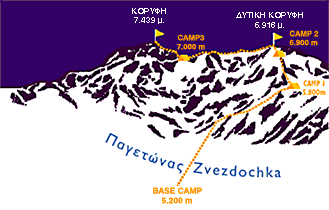


This is an abstract by mountaineer George Ganglbauer, from the Club's magazine.
I will refer to events that took place between 2.8.2000 and 14.8.2000, dates during which we left base camp in order to attempt a last approach to the mountain, myself and Nikos Hadjis.
2.8: we arrived to camp1 with heavy weather
4.8: we made an ascent to Dicky Pass, the most technical and dangerous part of the mountain, for recognition
5.8: we descended to the beginning of the glacier to take food the fuel for camp2
6.8: we arrived to 5200 m. through the difficult passes of Dicky Pass, where we organize camp2. We return to camp1 late at night.
8.8: ascending to camp2 following an dangerous adventure, since snowballs were there all the time; one actually touches us, but without adverse effects. 19:00 it starts to snow.
11.8: we remain in camp2. The temperature is very low, some 16-20 degrees below 0.
12.8: we decide to ascend to camp3, 5800 m. The snow though is much and the danger of snowballs obvious. So, we decide to descend to camp1, where we will think about what's next.
14.8: descending to base camp with much difficulty, since the crevasses are covered with snow and we fall in every now and then. We arrive at base camp late at night.
We decided to make one more attempt the next days, prolonging our remaining days on the mountain. The bad weather, though, that started on the afternoon of 15.8 and lasted till the 19.8 excluded every similar thought.


