On Tuesday, 24.3.98, a mountaineering expedition group of the Greek Climbing and Mountaineering Association has left for Nepal. The target of this expedition is to summit some peaks of the Himalayas, region Khumbu Himal, where the altitude is not so high, but the technical difficulty is extreme.On Tuesday, 24.3.98, a mountaineering expedition group of the Greek Climbing and Mountaineering Association has left for Nepal. The target of this expedition is to summit some peaks of the Himalayas, region Khumbu Himal, where the altitude is not so high, but the technical difficulty is extreme.
We would like to mention here that there is no communication with the group, so we can't have their news. The group does not carry a telephone device. Our latest connection has been held 15 days ago; they were already at the region's Base Camp, all very well, and ready to start their ascend.
The peaks to be visited are Kwangde Lho, 6.167 m., Graded Alpine D, TD, most possibly Tengkang Poche, 6.499 m., Graded Alpine D+ (the peaks are very close to each other, in a distance less than 2,5 kilometres, so they will try the latter one as well) and Kusum Kanguru, 6.369 m., Graded Alpine ED2, which is also the main target of the group.
Kusum Kanguru, which in Tibetan means "three snowy peaks", is an impressive peak of rock and ice, a complex of three main peaks, with at least five central cuts and five sides.
The northern part of the main peak, an ice wall 1.800 m., is the most beautiful. Prior the the first successful ascend in 1979, 4 more unsuccessful ones were attempted, among which the one of renowned climbers, such as Doug Scott, George Bettepourge or Mike Corington.
There were many attempts since 1987, some of them successful and those were the ones discussed in circles of mountaineers and climbers, since an ascend to Kusum Kanguru is a major mountaineering event.
It is certain that a success of the Greek expedition would improve the image of greek mountaineering and climbing, provide useful experience and ameliorate the conditions and prerequisites for a future successful greek expedition to a difficult peak (Κ2, Makalu, Everest).
The terms of participation were defines according to the difficulty of the expedition aim, and the selection of the team was carried out among climbers with a rich climbing portfolio, who had the technical background and the specialized experience required for climbing Kusum Kanguru.
The team consists of:
- Nikos Voutyropoulos
- Vag. Vroutsis
- Pan. Kotronaros
- Chr. Beloyiannis
- Dim. Bourazanis
- Pavlos Tsiantos
- Nikos HadjisYiannis Katrivanos, who is also the leader of the expedition.
The expedition will last approx. 45 days and all expenses are covered by the General Secretariat for Athletics.
The expedition - Main text from KORFES
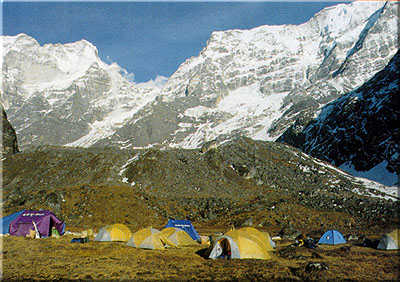 At base camp Kusum Kanguru, with the mountain in the backgroung |
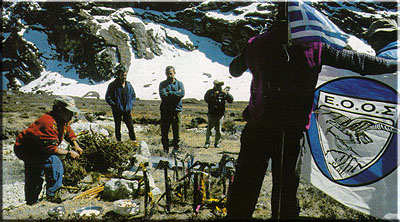 Preparing a fire for the sanctification of piolets |
A few lines cannot demonstrate the intense moments and the feelings emerging from an expedition to the Himalayan mountains. A rough note is useful though for those that wish to perform something similar in the future.A few lines cannot demonstrate the intense moments and the feelings emerging from an expedition to the Himalayan mountains. A rough note is useful though for those that wish to perform something similar in the future.
Our target was to summit 2 peaks, 6.000 m. each, Kusum Kanguru and Kwangde.
Both mountains are in the Khumbu area, very close to Everest. They are known as trekking peaks. One needs to trek very little to arrive at the base. Just 3 days for Kusum Kanguru and 4 for Kwangde. Kusum Kanguru is considered the most difficult trekking peak in Nepal.
After a wanderful trekking to Gokyo Peak for acclimatisation, we started for the base camp of Kusum. As we reached our target, a question became obvious:
How on earth are we going to summit this thing?
We decided to part in 2 groups in order to see about the ascent paths: one would try the north-eastern edge, the other the northern edge. We decided to part in 2 groups in order to see about the ascent paths: one would try the north-eastern edge, the other the northern edge.
The results: the first group, following a tiring 7-day ascent, made it to the top, at the northern edge.. Enough difficulties, ice to 70 and eock to level IV. The second group didn't make it. We tried to cover 1500 m. od difference in altitude in 2 days, at a site which Dong Score characterizes as "difficult". A snow-fall the second day gave us every excuse to return to base camp.
A second attempt to the NE edge was interrupted due to snow-fall. Dring their stay at Katmandu, the second group learned about the tragic death of Nikos Panadreou in Dhaulagiri.
Overall, the results are positive, we think. The expedition made us see that we can accomplish expeditions to high and technical Himalayan mountains, provided that the first snow-fall doesn't affect us negatively....
The mountains are there, waiting for us.