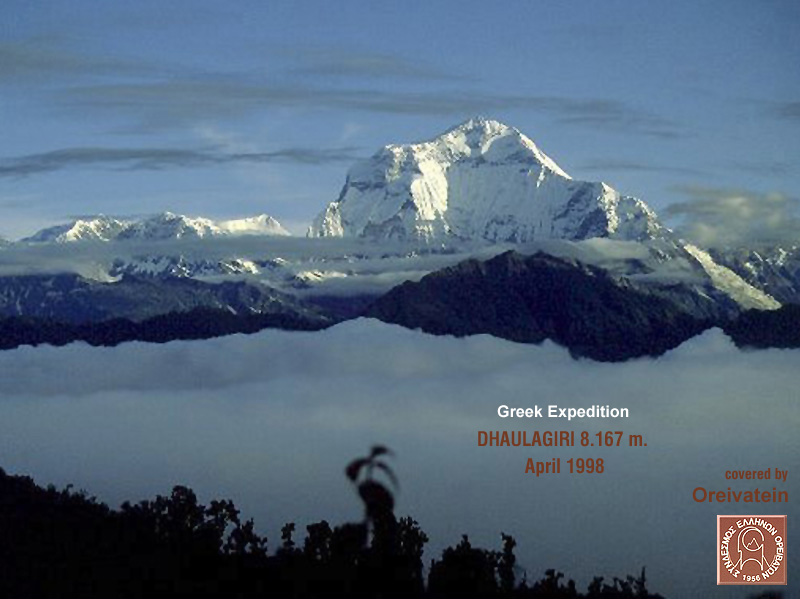

03.03.98 by Kostas Routsias, member of the Expedition
In the following article, an attempt will be made in order to give one possibly complete description of the venture to be tried, certain statistics about the mountain, as well as some personal views related to the mountaineering expeditions and the reasons why such ventures are attempted.
Personally, especially now that the time to go is close, I was intensely confronted with the question "why do you go to such mountaineering expedition, since the dangers are many and great?" "What is the purpose of your climbing?"
For those who seek a material objective, there is no satisfactory reply. For there is neither any desire, nor any expectation for a material . On the contrary, I would say that the participation of all the members of the expedition, is achieved with personal sacrifices, busynesswise and familywise. Nor the passion of mountaineering is the simple answer to those questions. For those people who believe so, this sport is, or should be a source of happiness. We climb the mountains because we enjoy it. Anyway, I doubt if any of the members of the team goes to Dhaulagiri with the expectation to enjoy the climb as much as he would enjoy it on one of the mountains of our country, for instance.
However, to climb on one of the 14 -above 8000 m. (26,000 feet)- peaks of the Himalayas, to be one of the few Greeks who ever attempted and succeeded the ascent on a peak like Dhaulagiri, is an irresistible magnet, from every aspect of human activity. I believe that this was the force to which Mallory gave in when he came up with an undoubtedly brilliant answer to the question, what is the purpose of the ascent of Mt. Everest: "Because it is there!".
Mountain climbing is not just an ordinary sport, of the kind that people participate in, in order to "burn" the surplus of their muscular force. It implicates a mental element too, which many times reaches the sphere of heroism, thus beautifying our life, because it adds to this life - in this age of technique, of technology and routine living- an ideal that is absent from our lives in general. Mountain climbing is the most exciting of the sports. The mountaineer is bound to move over a chasm for a few seconds or for up to several days. He has to ascent for a few meters or for many kilometers. He has to confront below zero temperatures, fierce winds, lethal avalanches, hunger, thirst, insufficiency of sleep, the deadly high-altitude sickness caused by the insufficiency of oxygen and the atmospheric pressure. The exhaustion, the lack of communication, the loneliness, the accidents, even death.
You have to confront all of the above in order to reach your objective, which is the ascent to the peak. There is no material profit. The climber, by overcoming all of the above mentioned adversities, he in fact overcomes his own self. The body becomes the instrument of his mind and spirit. He is forced to draw strength directly from his spirit. He subdues, the toughest opponent, his own self. He becomes a fellow feeling person and an altruist.
The Dhaulagiri peak is there; what if other climbers have conquered her before? She stands there, towering, unapproachable, proud. Such an arduous ambition constitutes one true challenge for the human nature. The human - climber will always have the desire to rival against the impossible, the "purposeless". [*]
What is a mountaineering expedition?
Irrespectively from the existing opinions concerning mountaineering, it seems that everybody agrees that mountain climbing and consequently the big climbing expeditions are a great adventure. Frankly, participation in such an adventure is really worth the trouble. A great desire that any of us may have, is fulfilled. We daily struggle trying to overcome our own self. We live moments of unequalled magnificence. We forge a great companionship amongst us and we reap the fruits of such a friendship in our personal, everyday life.
It is well known that the Himalayas are the greatest sierra in the world. An unbelievably unapproachable geographic anaglyph, without roads, almost uninhabited. All the great - above 8000 m. - peaks are located hundreds of kilometers away from any cities… The first expeditions to those peaks, were forced to traverse great distances, carrying tons of supplies for the needs of the people of the expedition for many months. For the portage of those supplies, the services of thousands of the natives were required. The areas are so inaccessible, that only humans can be used for the portage of hardware and supplies. Setting up and supervising of so many people is more or less like a "military operation" and the costs for such expeditions are colossal.
Since then, the conditions have changed enough. Although the problems are fewer today, they still exist. Any attempt to ascend to peaks beyond the 8000 m. calls for organization and preparations similar to (although of a smaller scale than) the first expeditions, since the portage of the suplies is still carried out the "traditional" way, by humans, that is.
To organize a climbing expedition to one of the above 8000 m. peaks, is a tremendous task. My personal experience is not particularly great, let alone the experience I acquired during the expedition to Aconcagua, but, I can deeply sympathise with all of those who have the responsibility to devise a plan and take care of the preparations of such expeditions. In particular, I sympathize with the leader of our expedition Mr. A. Sikaris who is commissioned with this task. Just imagine that these people are in charge to provide here-and-now, the solutions to problems we will encounter in a far and uninhabited region of the globe, where the climatic conditions are horrible.
They must solve problems like: The members of the team must be suitably dressed and properly equipped to accomplish their mission under extremely adverse conditions. To pursue all the necessary hardware that they might possibly need. They must make arrangements for supplies for the entire period of time they will be away from the civilized world and they must be carefully selected. Preparations must be made for the packaging, checking out and transportation of hardware and comestibles. Last but not least or smaller of these multifold headaches, and the most important in the entire venture, is the financial issue. How to procure the funds necessary for the success of the venture.
Choosing Dhaulagiri
Human activities, either concerned with technical \ economical objectives, or approaching cultural necessities, they must mutually aim towards the improvement of the quality of life and the spiritual development. These activities must be defined by the principles of progress and progress.
SEO, having faith to these maxims, as well as to the principles of the association, continuously attempts for harder and more difficult ventures in the fields, which the association is active. Judging therefore, that the association, as well as the Hellenic Mountaineering in general, contains the potential, which could conquer the most difficult and the highest peaks on Earth, sends a mountaineering expedition to the peak of DHAULAGIRI, Himalayas, in the land of Nepal.
[*] Dhualagiri is one of the 14 highest mountains in the world whose elevation exceeds the 8000 m. The climb to the peak requires many days of trying on inhospitable landscapes, on perpendicular planes, on frozen sides, on planes swept by lethal avalanches. The unstable weather conditions, with fearsome winds and, way bellow zero temperatures, plus the perilous sicknesses of the mountain, will constitute one more obstacle in the way of the expedition's attempt. However, this expedition, with the particular members, administers all of the prerequisites that can guarantee for the success.
Information data
The first photos of the mountain by air were taken in 1949. From 1950 till 1959, French, Swiss, Argentineans and Austrians made attempts to ascent to the peak. All attempts on the north side have failed at the 8000 m. mark.
The first successful ascents on the mountain were on May 13 and 23, 1960, by the Swiss mountaineers E. Forrer, A. Schelbert, M Vaucher, H. Weber, the Austrian K. Diemberger, the German P. Diener and the Sherpas Nyima Dorie and Nawang Dorji. They ascended on the Northeast side of the mountain.
On October 1990 a Greek expedition of seven member of E.O.S of Athens headed by I. Katrivanos, and P. Chlorokostas, D. Titopoulos, N. Brokos, H. Lambris, V. Vroutsis and D. Karayianni as members, attempted an ascent on Dhaulagiri from the NE edge. Unfortunately, they did not succeed to climb on it and two of the members of the expedition, V. Vroutsis and H. Lambris, made it up to 7600 m. but they were forced to stop, with obvious signs of frost bites and pulmonary oedema.
The members of the expedition
Sykaris Antonis
Age 35. Born in Athens. Leader of the expedition. Member of S.E.O of Athens. Businessman. Highest peak: Pumori - Nepal, 7.161 m./td>
Avgerodemos Panagiotis
Age 28. Born in Athens. Member of S.E.O of Athens. Medical doctor. Highest peak: Acongangua - Argentina, 6.959 m.
Voutiropoulos Giorgos
Age 28. Born in Aliveri - Evoia Island. Member of E.O.S of Athens. Historian. Highest peak: Tajikistan, Communism, 7.495 m.
Kallos Demitris
Age 30. Born in Ioannina. Member of E.O.S of Ioannina. Technician for medical equipment . Highest peak: Pumori - Nepal, 7.161 m.
Lazaridis Stavros
Age 30. Born in Munich - Germany. Member of O.L of Thessaloniki. Tourist agent. Highest peak: Tajikistan Korzenevska , 7.105 m.
Bouyiouklou Alexandros
Age 28. Born in Xanthi. Member of E.O.S of Xanthi. Works for the Municipality of Xanthi. Highest peak: Pumori - Nepal, 7.161 m.
Papandreou Nikos
Age 43. Born in Andravida. Member of S.E.O of Athens. Businessman. Highest peak: Acongangua - Argentina, 6.959 m.
Routsias Kostas
Age 41. From village Pteleo - Magnesia. Member of S.E.O of Athens. Civil Engineer. Highest peak: Acongangua - Argentina, 6.959 m.
Tsoupras Charalabos
Age 35. Born in Senades - Arta. Member of E.O.S of Athens. Post Office Employee. Highest peak: Tajikistan, Communism, 7.495 m.
Bibliography
John Hunt: "Under the roof of the World"
Kostas Tzivelekas: "Everest 96"
Detailed schedule
13.3.98: Departure from the Athens airport
14.3.98: Arrival at Katmandou, Nepal
15-17.3.98: Final organisation of the expedition through bikram and the Ministriy of Tourism of Nepal.
We will buy all the equipemt for the food, in accordance with the cook of the expedition
, as well as all the pre-calculated food.
18.3.98: Departure by bus to Pokhara, together with 2 high altitude porters, the cook and his 2 helps and all the equipment.
19.3.98: Stay at Pokhara for the final preparations.
20.3.98: Fly by charter to Jomosom, 2.713 m.
21.3.98: Gathering of all porters for the transport of the equipment to Base Camp. Trekking to Yak Kharka for acclimatisation and return to Marpha
22.3.98: From the center of Marpha we start ascending to the left along a sandy and rocky gradient and then we proceed along a difficult mountain zig-zag track. At the end of this track we turn left. We go across the stream and we take the mountain track leading up and left. From here we can see Dhualagiri I and the Tukuche Peak on our right; as we go up the crest, we meet 2 huts with only the 4 walls standing. We enter anew the mountain track, and now the gradient increases and the track gets narrower. As we go around a branching of the crest, originating from the main crest, we arrive at Yak Kharka, where we can prepare our tents for the night.
From Marpha (2.667 m.) to Alumbari (3.900 m.), 3,5 hours. From there to Yak Kharka (4.200 m.), 2,5 hours. (overnight in tents)
23.3.98: The vertical path along a difficult mountain slope continues. We go around the mountain slope to another bivouak cave like the one at Yak Kharka. As we mount to the Thapa peak, the gradient diminishes. We then ascent to the Thapa Pass and a little later to the Hidden Valley (4.915. m.)
Dhaulagiri I is hidden by the Tukuche Peak (6.920 m.). Trekking 5 hours.
24.3.98: From the Hidden Valley camp we go towards the French Pass (5.360 μ.) and from the we arrive to Base Camp.
25.3.98: Start of the ascent, see the climbing plan
10.5.98: End of the ascent
11.5.98: Hidden Valley
12.5.98: Josomon
13.5.98: Pokhara
14-15.5.98: Katmandou
16.5.98: Departure for Athens
18.5.98: Arrival in Athens
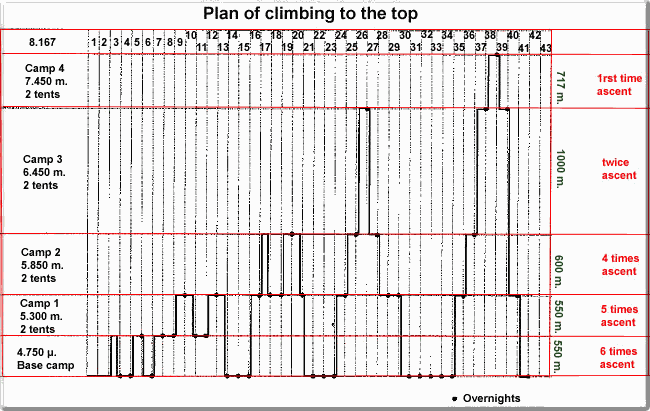
From Base Camp 4.700 m. we move in a glacier. At its right, there is the danger of stone-fall. For this reason, any movement should be effected in the morning. A dangerous path of approx. 200 m. We still remain in the glacier, where there are only grevanches. So, we arrive at the 1rst camp after 4 hours.
1rst camp: 5.300 m. to 2nd camp 5.850 m. Smooth gradient, need for 2 battons. Trekking for about 2 hours.
2nd camp: 5.850 m. to 3rd camp 6.450 m. Bigger gradient. Trekking for 4,5-5,5 hours.
3rd camp: 6.450 m. to 4rth camp 7.450 m.
The hardest part, divided in its first 400 m (6.400-6.800) in snow or ice, the gradient being up to 45o
The second part (6.800-7.100) is also divided in snow or ice, but the gradient is 55-60o and locally up to 70o.
At 7.100 we cannot prepare our tents and we will have to move further for 350 m. more
(7.100-7.450) Where we meet diffucult, mixed paths, we will prepare our 3 camps, where 2 characteristic huge rocks prevail. The plateau is not very large, but we can prepare 2 tents with no problem. Total duration: over 8 hours.
4rth camp: 7.450 to the top 8.167 m.
From the 4rth camp we move to the right, 40o, we avoid some rocks a little after and we then move to the left, 45o, till the start of the slope, at 7.900 m.
There is here also a danger of snow layer unsticking, and the danger of one being swept away if one hasn't got the time to secure oneself. There are no stable ropes at this part of the track, as well as at the former one.
From 7.900 m. we follow the slope to the right and after a while we arrive to the top.
Total duration: approx. 8 hours. Return to the 4rth Camp after approx. 6 hours.
You can hear part of the speech by the leader of the expedition.
Parts of the speech of Mr Nikolaou, president of SEO, were as follows:
As president of the SEO I have the pleasure and the honour to announce that the big mountaineering expedition, which has been prepared and organized for months now by our Club for the conquer of Mt Dhaulagiri, is ready and starting in a few days, namely on the 13th of March, in order to give birth to our aims......
To what concerns expeditions to mountains of abroad, SEO has already organised tenths of expeditions in mountains such as the Alps, Fuji Jama, Japanese Alps, Kenya, Kilimanjaro, Caucasus, Aconkagoua, Pamir-Imalayas.....
The expedition will leave on the 13th of March, from the Athens airport and through Rome-New Delhi, it will arrive to Katmandou, in Nepal. It will then go west by road (500 km) and reach the town of Pokara. It will then fly to Djomsom, from where it will start trekking in order to reach Base Camp..
Accompanied by 70 porters, 20 yiaks and 3 tons of equipment and amunition, the group will hike for 7 days through diffucult tracks and arrive at 4.500 m, where the Base Camp is situated. After it gets acclimatized, it will start climbing to the top..
We evaluate that the whole expedition will last 2 months from the day of departure."
Then Ms Arvaniti, for sponsor SONY, greeted the expedition. Finally, Mr. Sykaris, leader of the expedition, referred in detail to the physical and psychological state of the group as well as the trip to Base Camp.
Oreivatein will be back with them and with you on Friday, for the departure to Nepal.


Watch or listen to the description of the trip from the leader of the expedition


Oreivatein had prepared a wallpaper for the expedition to Dhaulagiri: "A contribution from Oreivatein, in order to make this big expedition known to the world."